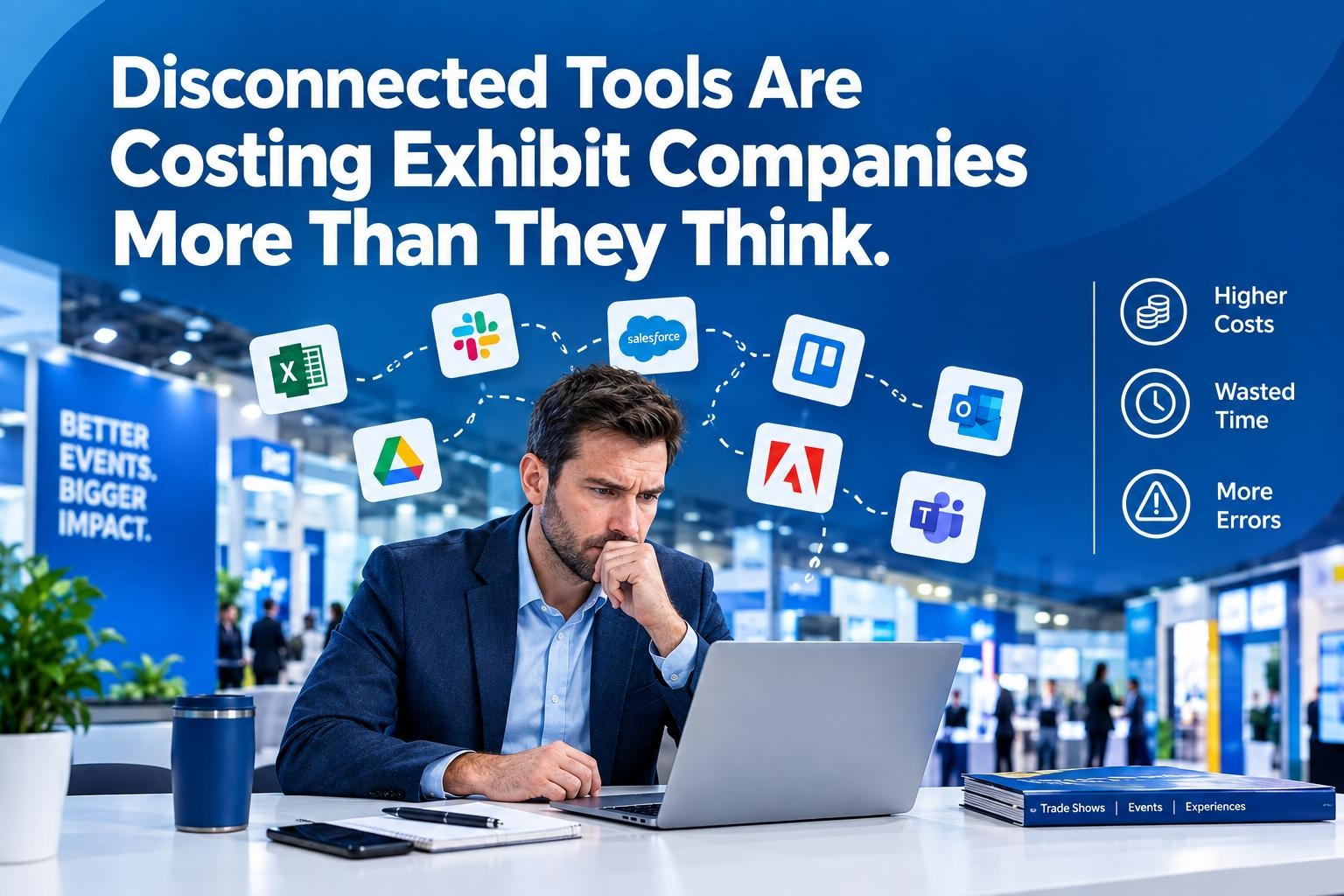
Why Fragmented Tools Are Costing Exhibit Companies More Than They Realize
Fragmented tools can quietly drain time, increase operational costs and create unnecessary dependencies on individual expertise. This article explores how exhibit companies can overcome these challenges by adopting connected event management software that centralizes exhibit asset management, preserves institutional knowledge and standardizes workflows.
Exhibit companies that scale successfully,and the large organizations that run events at volume, share a common characteristic: they've moved from depending on individual expertise and fragmented tools to operating on a cohesive, connected platform. That platform centralizes exhibit asset management, holds the institutional knowledge,enforces the process and gives every team member and event rep what they need without requiring them to already know it.
This article makes the business case for that shift: what a cohesive event management software means, what it's worth and why moving to purpose-built SaaS asset management software is one of the highest-return operational investments an exhibit company can make, regardless of size.
What "Cohesive" Means and Why It Matters
The word cohesive gets used a lot in software marketing, so it's worth being specific about what it means here.
A cohesive event management software is one where every function in your operation; inventory tracking, order management,client communication, asset maintenance, logistics coordination and reporting, runs through a single connected system. Data entered in one part of the platform is immediately visible everywhere else and actions taken by one team member update the picture for every other team member in real time.
The opposite of cohesive is fragmented; inventory in one spreadsheet, orders in email, client notes in a project management tool, shipping records in a separate document, maintenance logs kept by the warehouse manager in a notebook. Each of these tools might work adequately in isolation. The problem is the gaps between them, the places where information must be manually transferred, where updates made in one place don't automatically appear in another, where the whole picture only exists in someone's head.
Fragmented operations don't fail because the individual tools are bad. They fail because the gaps between tools are where errors live. A cohesive platform closes these gaps by replacing multiple disconnected tools with one connected system built specifically for exhibit operations.
The Business Value: What the Shift Actually Delivers
The case for a cohesive SaaS platform isn't just operational, it's financial, strategic, and competitive. Here's how the value breaks down across the dimensions that matter most to exhibit companies and operations leaders.
1. Direct Cost Reduction
The most immediate, measurable value of a centralized platform is the reduction in operational costs that comes from eliminating the errors and inefficiencies of fragmented systems.
Double bookings that require emergency rentals. Assets that go missing because nobody tracked their return. Orders mis-entered from email and discovered wrong at the event venue. Rush shipping for items that could have been planned with better visibility. These aren't occasional occurrences in a manual operation, they're structural features of a system that depends on everyone doing everything correctly, every time.
Event Express users report an average 37%reduction in operational costs after switching from manual tracking methods, this efficiency is achieved through streamlined reconciliation workflows and optimized asset utilization across maintenance and inventory. It reflects the same operational gains that enterprise asset management software has delivered in manufacturing, logistics, and retail for years, now available to exhibit companies through platforms purpose-built for their industry. For a mid-sized exhibit company, that percentage represents a meaningful sum, one that compounds annually once asset management software has been implemented.
2. Team capacity and scalability
One of the most significant constraints one exhibit company growth is the ratio of operational staff to client volume. In a manual operation, adding clients means adding headcount, more account managers to handle orders, more warehouse staff to manage coordination overhead, more administrative support to keep information flowing.
SaaS asset management software breaks that ratio. When orders flow through a structured system instead of emails and spreadsheets, when inventory updates automatically and when clients self-serve through their own portals instead of requiring account manager involvement for every request, the same team can serve a larger client roster without proportional headcount growth. This is the operational leverage that transforms a services business from one that scales linearly to one that scales efficiently,replacing a variable cost in time with a fixed platform cost that improves as client volume grows.
3. Client retention and revenue protection
Client churn in the exhibit industry is often attributed to relationship factors, a key contact leaving, a competitor offering better pricing, a strategic shift in the client's marketing program.These are real factors. But a significant share of churn is driven by something more operational: the client's day-to-day experience of working with you.
A client who must send emails and wait for responses to order assets. A client whose booth arrived at a venue with unreported damage. A client who has to ask for status updates because there's no visibility into their shipment. These friction points accumulate. They rarely trigger an immediate switch, but they make the client receptive to a competitor offering a smoother experience.
A centralized platform addresses these friction points directly. Branded self-serve portals give clients a professional ordering experience tailored to their asset library. Real-time tracking means your team can answer status questions instantly. Proactive exhibit asset management means damage is caught, documented, and resolved before it reaches the venue, not discovered by the client on the show floor.The client's experience improves not because you hired better people, but because your system supports a better process, and retaining a client costs a fraction of acquiring a new one.
4. Data-driven decision making
One of the quiet advantages of running operations on SaaS asset management software is the data it generates automatically. Every order, deployment, maintenance event, and client interaction is recorded, timestamped, and accessible without anyone having to manually log it. Over time, that data becomes a strategic asset that shapes smarter decisions across the business.
Which assets generate the most utilization?Which clients are growing their show schedules and might be candidates for expanded service agreements? Which inventory items have accumulated enough maintenance cost to justify replacement? In a fragmented operation, these questions can only be answered by manually pulling data from multiple systems,emails and spreadsheets, a process that is both resource-intensive and an operational burden. In a centralized platform, the answers are a report away, and decisions that used to be made on instinct are based on evidence.
5. Organizational resilience
Every exhibit company that depends on individual expertise rather than institutional systems carries a risk: key person dependency. When the knowledge of how the operation runs lives in the minds of a few experienced team members rather than in a documented, accessible system, the departure of any one of those people creates immediate operational vulnerability.
A centralized platform is an antidote to this risk. When every client's asset history, order history, and communication record is in the system, a new team member can get up to speed on any account in minutes rather than weeks. When the fulfillment workflow is defined and enforced by the platform rather than held together by tribal knowledge, the operation continues running smoothly as people change. The institutional knowledge belongs to the company, not the individual.
Together, these five dimensions, cost,capacity, retention, decision quality and resilience explain why asset management software is best understood not as a software purchase, but as an operational upgrade with returns across the entire business. In Part 2, we look at what this shift looks like for exhibit companies of different sizes, and the signals that indicate it's time to make the move.